
Best Paper Award: Shortlisted
PANEL 5: Urban Lives, Memory, and Literary Urbanisms
Best Paper Award: Shortlisted
- PANEL 5: Urban Lives, Memory, and Literary Urbanisms
Spectral Presence in Kowloon Walled City: Negotiation of Meaning and Post-spatial Economic Mechanisms from a Historical Ethnographic Perspective
Yang, Jiahua
Hong Kong Baptist University
Abstract
This study examines how Kowloon Walled City obtained a sustained “afterlife” in contemporary culture following its physical demolition in 1994. In response to the traditional view that “physical erasure is the end of culture,” this paper proposes that demolition is not the end, but a prerequisite for the transformation of the Walled City into a Spectral Presence that can be reproduced. Adopting historical ethnography as a central framework, this study considers the Walled City as a field of meaning across time and space. Using “visual discourse analysis” and “close reading”to compare the photographic collection City of Darkness, government spokespersons, and specific historical documents (representing past realities and stigmas) with the 2024 film Twilight of the Warriors: Walled In (representing contemporary nostalgic reconstruction), and this analysis illuminates how current cultural producers and consumers negotiate the significance of this vanishing space. Theoretically, this study combines Ackbar Abbas’s Politics of Disappearance with Jacques Derrida’s Hauntology to analyze the dynamics of production that underpin this “afterlife”. The study finds that in the context of globalization, the identity of the afterlife has been transformed into a dynamic path of production. The study finds that, driven by identity anxiety (as cultural knowledge) in the context of globalization, the Kowloon Walled City is reconstructed through media re-creation (as cultural behavior). This process transforms the original “extralegal enclave” into a “Spectral Interface,” (as cultural artifact) a nostalgic utopia between historical loss and contemporary desires. Finally, this paper aims to summarize the mechanism of the “PostSpatial Economy” and explain how economic value is generated from the negotiation of disappearance, selective nostalgia, and the “culture of absence”.
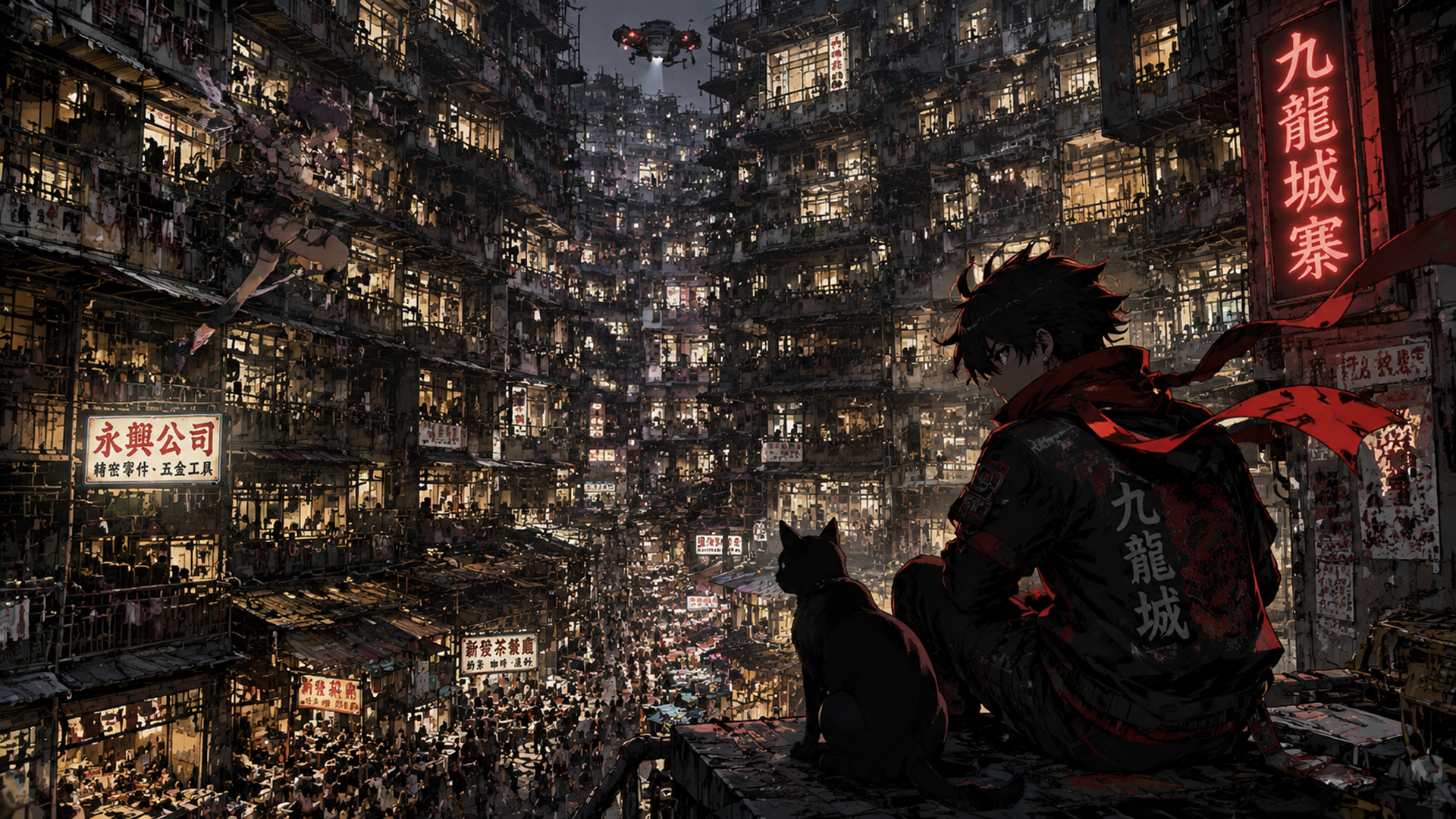
Credit line (suggested): "AI-generated image depicting Kowloon Walled City. Created by the author, 2026."